How to Identify and Fix Hidden Control Loop Oscillations Before They Cost You
Est. Reading: 7 minutes
How to Identify and Fix Hidden Control Loop Oscillations Before They Cost You 6
Most control loop oscillations do not announce themselves. They build gradually — a slightly wider PV swing here, a busier controller output there — until one day an operator notices product going off-spec, energy consumption spiking, or a control valve worn out ahead of schedule. By that point, the damage is already done.
Control loop oscillation troubleshooting is one of the highest-ROI activities a process engineer can perform — but only when approached systematically. This article walks through the three root causes responsible for the vast majority of oscillating loops, how to distinguish between them from trend data alone, and how APROMON and PITOPS turn what used to be a weeks-long investigation into a structured, rapid corrective workflow.
The Hidden Cost of Oscillating Loops
Industry benchmarks consistently show that 70–80% of industrial plants operate with suboptimal PID loops[2] [3] — not because of poor initial engineering, but because oscillations develop gradually as equipment ages, valve packing tightens, and process dynamics shift. A single major facility typically loses 5–15% of process margins annually [2] through undetected control loop issues, including excess energy consumption, extended cycle times, and product quality variability.
Oscillations are particularly deceptive because they frequently appear stable on a DCS overview screen. The PV is near the setpoint. Alarms are quiet. Only when you look at a properly scaled trend of PV, SP, and OP simultaneously does the oscillation pattern emerge – and with it, the root cause.[4]
Before touching a PID parameter, the root cause must be confirmed. The three dominant root causes are explained below, and each produce a distinct signature in the PV and OP trends.[4] [8]
1. Valve Stiction — The Slip-Stick Limit Cycle
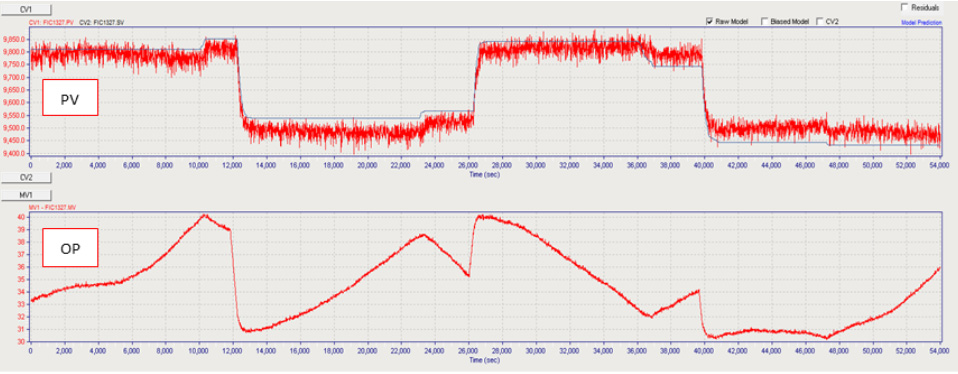
Valve stiction (static friction) is one of the most common and destructive killer of control loop performance. When packing friction prevents the valve stem from moving, the integral action of the PID continues to ramp the controller output. Pressure builds until the valve suddenly “jumps” past its target — overshooting the process variable — and the cycle repeats in the opposite direction.[1] [8]
Stiction Signature – PV oscillates in a square-ish wave; OP ramps continuously in a sawtooth (triangle) pattern. The controller is integrating to push the stuck valve, which then jumps.
How to Identify and Fix Hidden Control Loop Oscillations Before They Cost You 7
Figure 1. The PV exhibits a characteristic stepped pattern, jumping sharply between levels, while the controller output (OP) ramps continuously in a sawtooth pattern as the PID integrates against the stuck valve. No amount of retuning will eliminate this oscillation – valve maintenance is required.
2. Aggressive Controller Tuning — Excessive Proportional or Integral Action
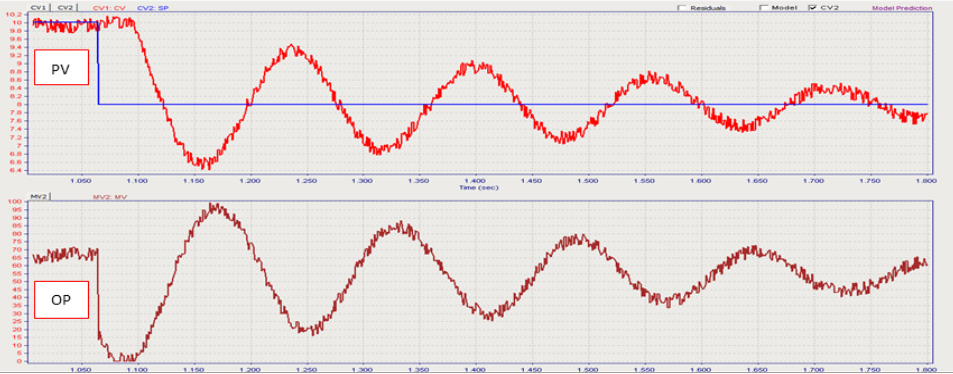
When proportional gain (Kp) or integral time (Ti) exceeds the stability margin of the process, the closed-loop system enters a state of marginal or sustained oscillation. Unlike stiction-driven cycles, tuning-induced oscillations are directly responsive to controller parameter changes: reducing proportional or integral strong effect will reduce or eliminate the oscillation. The OP and PV oscillate simultaneously at the same frequency with a sinusoidal, not square-wave, shape.[4] [5]
Tuning Signature — Both PV and OP oscillate sinusoidally at the same frequency. The oscillation will not appear in Manual mode — it only occurs with the controller in Auto.
How to Identify and Fix Hidden Control Loop Oscillations Before They Cost You 8
Figure 2. Both the PV and controller output (OP) oscillate sinusoidally following a setpoint change. This is the hallmark of aggressive tuning – reducing proportional gain or increasing integral time will reduce or eliminate the oscillation.
3. External Disturbances
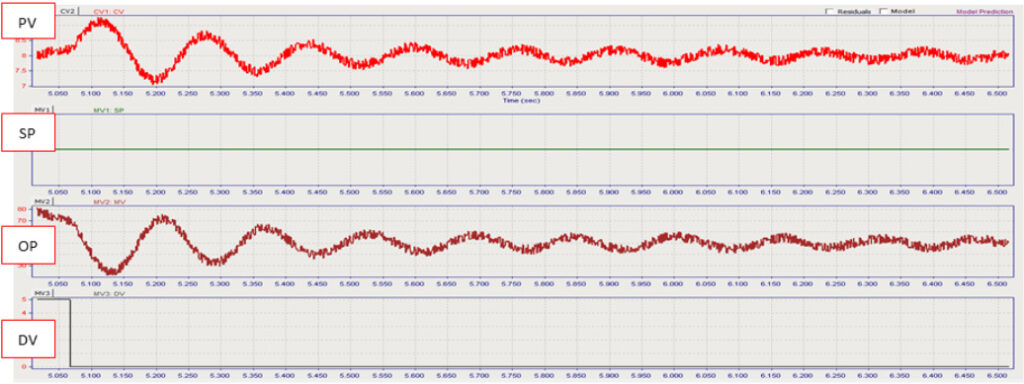
A third category of oscillation is driven neither by valve mechanics nor by controller tuning, but by an upstream disturbance — such as: pressure surge, a feed flow variation, or the oscillation of another control loop propagating through shared process streams. These oscillations persist even when the analyzed loop is placed in Manual mode, which is the definitive diagnostic test. Addressing them requires tracing the disturbance to its source rather than modifying the tuning of the affected controller.
Disturbance Signature — PV oscillates in both Auto and Manual mode. The oscillation frequency often matches the cycle time of an upstream loop.
How to Identify and Fix Hidden Control Loop Oscillations Before They Cost You 9
Figure 3. Following an external disturbance (DV), the PV continues to oscillate around a fixed setpoint (SP) with no controller or setpoint changes involved.
Each root cause produces a distinct signature in the PV and OP trends. The table below summarizes the key diagnostic patterns and recommended corrective actions for the three most common oscillation types.
Table 1. Root Cause Identification Guide
PV / OP Pattern
Root Cause
Recommended Action
Square PV wave + sawtooth OP ramp
Valve stiction (slip-stick cycle)
Valve diagnostics – stiction index test with PITOPS; continuous monitoring with APROMON
Oscillation changes when Kp is reduced
Aggressive proportional or integral action
Re-identify process model with PITOPS; retune; monitor with APROMON
Oscillation unchanged across tuning adjustments
External disturbance or upstream loop interaction
Trace disturbance propagation with APROMON
APROMON: Quick and Reliable Continuous AI-based Oscillation Detection
Manual trend inspection is practical for a handful of loops, but most industrial facilities operate with hundreds or thousands of PID controllers simultaneously. APROMON (Advanced PROcess MONitoring) from PiControl Solutions addresses this challenge by continuously analyzing every basic or advanced (APC) control loop, or a model predictive controller (MPC) in the plant and automatically flagging performance degradation before it reaches an operational threshold.[2] [3]
At the core of APROMON’s oscillation detection capability is the True Amplitude Detection (TAD) algorithm[3] — the most advanced and reliable AI-basedoscillationdetection engine available for industrial process control. TAD is specifically designed to distinguish genuine process oscillations from measurement noise, signal drift, and process complexity. It traps oscillations only when their amplitude is large enough to cause real operational impact, eliminating false alarms that erode operator confidence.
PITOPS: Fixes PID/APC Challenges Without Disrupting the Process
Once APROMON identifies a controller requiring re-tuning, PITOPS (Process Identification and Controller Tuning OPtimizer Simulator) provides the engineering framework to determine and implement optimal new PID or APC parameters. The critical differentiator of PITOPS is its ability to perform complete closed-loop system identification — calculating accurate process transfer function models, while rejecting and isolating unmeasured disturbances, by using only routine stepless closed-loop operating data, with PID control loops in Auto or Cascade mode and APC/MPC active.[7]
Traditional system identification requires taking the loop to Manual and performing many disruptive open-loop step tests — an approach operator reasonably resist because it interrupts production and introduces process risk in a long run. PITOPS eliminates this requirement entirely. Many times, with past stepless closed-loop data, or in a case when they is no cause and effect in data, only one or two routine setpoint changes performed in Auto mode provides sufficient scenario for PITOPS to identify one or several process models with high accuracy, and compute optimized P, I, and D parameters that deliver robust closed-loop performance. [7]Beyond re-tuning, PITOPS also plays a direct role in confirming valve stiction. By analyzing the relationship between controller output and process variable movement during closed-loop operation, PITOPS can quantify the stiction index — the minimum controller output change required to produce measurable valve stem movement. This provides an objective, data-driven basis for maintenance work orders, replacing the guesswork of visual trend inspection with a precise mechanical diagnosis that maintenance teams and reliability engineers can act on immediately. [7] [1]
Why PITOPS Outperforms Other Technologies?
Can work with past stepless closed-loop data – no need for any open- or closed-loop plant step-testing [7]
Does not require any data precondition – not sensitive to industrial data complexity, such as noise, spikes, missing or frozen data, drifts or unmeasured disturbances[7]
Detects and isolates unmeasured disturbances during model identification, while calculating pure process models[7]
Can improve MPC models using the data when these controllers were ON and running[7]
Mathematically calculates tuning parameters that match any DCS/PLC equation formats exactly[7]
Tune PID controllers based on existing process objectives, such as step/ramped/complex
Tune PID controllers based on existing process objectives, such as step/ramped/complex
Tune PID controllers based on existing process objectives, such as step/ramped/complex setpoint changes, disturbance rejections, valve stiction, PID OP ROC, and many other objectives[7]
Designs and optimizes PLC-DCS-based APC controllers mathematically and precisely[7]
The Three-Step Correction Workflow
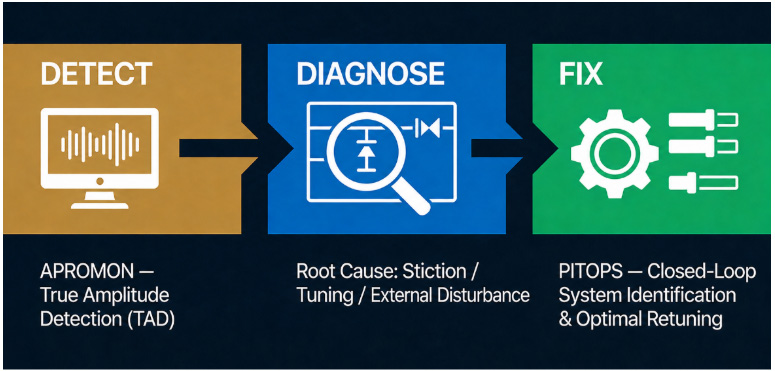
Effective control loop oscillation troubleshooting follows a disciplined sequence. Skipping the root cause step — going directly to PID re-tuning — is the single most common mistake in industrial loop maintenance, and it explains why many facilities re-tune the same loops repeatedly without lasting results.[4] [8]
Step 1 — Detect: APROMON continuously monitors all controllers and flags oscillating or degrading performance using TAD algorithm. Engineers receive prioritized alerts with controller-specific diagnostic data — no manual trend scanning required.[2] [3]
Step 2 — Diagnose: Examine the PV/OP pattern for the root cause signature.
Is the OP following a sawtooth ramp with a square-wave PV? Likely stiction — and PITOPS can quantify the stiction index directly from closed-loop data to confirm and document the finding.
Does the oscillation disappear in Manual? Likely a tuning issue.
Does it persist in both Auto and Manual? Trace the upstream disturbance using APROMON’s cross-loop correlation.[3] [7]
Step 3 — Fix: For stiction: use the PITOPS stiction index to justify and scope the valve maintenance work order, then re-tune with PITOPS after repair. For tuning issues: use PITOPS to identify the current process model from closed-loop data and calculate new optimal PID parameters. For disturbances: address the upstream source. After any implementation, APROMON validates the performance improvement against the pre-correction baseline.[2] [7]
How to Identify and Fix Hidden Control Loop Oscillations Before They Cost You 10
Figure 4. The PiControl Solutions workflow: DETECT with APROMON TAD, DIAGNOSE the root cause (including PITOPS stiction quantification), FIX with PITOPS closed-loop system identification and retuning.
What Systematic Oscillation Elimination Delivers
Organizations that implement continuous controller monitoring combined with systematic re-tuning methodology consistently report measurable operational improvements. The benefits are not the result of individual heroic interventions – they emerge from building a structured, repeatable process that catches degradation early and corrects it before cascading losses occur.[2] [3]
3–8% energy reduction from improved controller efficiency and reduced valve cycling[2]
Extended equipment lifespan — earlier detection of valve wear and actuator issues reduces emergency maintenance[1]
1. PiControl Solutions, “The Hidden Culprit: Best Practices for Control Valve Diagnostics in PID Loop Performance,” February 2026. www.picontrolsolutions.com
2. PiControl Solutions, “Maximize Profits in Manufacturing Factories — APROMON and PITOPS Overview,” March 2026. www.picontrolsolutions.com
4. Smuts, J., “Automation Basics: Closed-Loop Control Troubleshooting,” ISA InTech, 2018/2022. www.isa.org
5. Thornhill, N.F. & Hägglund, T., “Detection and Diagnosis of Oscillation in Control Loops,” Control Engineering Practice, Vol. 5, No. 10, pp. 1343–1354, Elsevier, 1997.
6. NTNU Open, “Controller Performance Monitoring: Detection and Diagnosis of Oscillations in Control Loops,” Doctoral Thesis, 2018.