Latent Heat, Vacuum, and Steam Economy: The Double-Effect Evaporator, Simulated in Real Time
Est. Reading: 6 minutes
A single-effect evaporator burns roughly one kilogram of steam for every kilogram of water it removes. That is the deal, and thermodynamics does not negotiate it.
Now add a second effect. No bigger boiler, no extra fuel, no new energy source – just a pipe that carries the first effect’s vapour into the second effect’s heating coil instead of venting it. That same kilogram of steam now removes 1.3 to 1.65 kilograms of water [1][2]. A 30–65% gain in output for the price of some piping and a vacuum pump, which is why multi-effect evaporation has been standard practice in sugar, paper, desalination and dairy for more than a century [3].
Which raises a fair question: if the trick is that cheap, why isn’t every evaporator on earth running ten effects?
Because every effect you add is another vessel that has to be started in the right order, another pressure that has to be established before the one downstream of it will behave, and another way for the whole train to quietly fail to light off while every gauge on the panel still looks plausible. Multi-effect evaporation is not hard to understand. It is hard to operate — and that difficulty seldom survives the trip into a textbook, because a textbook shows you the answer at steady state and skips the ninety minutes it took to get there.
PiEvap is where those ninety minutes live.
Three Things Have to Be True Before the Vacuum Pump Does Anything
The second effect only earns its keep under vacuum. Drop the pressure in EF-02 to about 20 kPa absolute and water boils at roughly 60 °C instead of 100 °C [4] — which is precisely what allows the first effect’s modest vapour to boil the second effect’s liquid at all.
Most simulators model this as a switch. Pump on, vacuum appears.
PiEvap doesn’t. Inside the simulator, EF-02 pulls vacuum only when three independent conditions hold at the same time:
The vacuum pump P-01 is running.
A condensate path is actually open through the condenser — at least one of the two product-vessel inlet valves is open.
Both product vessels are sealed — each one either holds a liquid seal, or has its drain valve shut.
Start the pump without a condensate path open, and nothing announces it. The pump runs, the pressure indicator sits stubbornly near atmospheric, and the second effect simply never begins evaporating. There is no hint and no pop-up — there is a reading that isn’t moving, and an engineer who has to work out why. That is exactly how it behaves on real equipment.
The liquid seal is handled differently, because on real equipment it is protected. Try to open a product-vessel drain while the vacuum pump is running, and that vessel is sitting below its seal level, and PiEvap refuses the command outright: the entry snaps back to zero, and the vessel is flagged Low Liquid Level — Vacuum Breach. It is not a scolding message about a wrong answer — it is the same interlock logic that stops an operator from breaking vacuum on the real unit, and it teaches the reason the seal exists far better than a paragraph about it would.
The Two Effects Are Genuinely Talking to Each Other
The liquid transfer between the effects is not a scripted flow rate. EF-01 and EF-02 are modelled as communicating vessels: the driving force is the differential head between the two sight glasses, so flow slows as the levels converge, stops when they equalise, and cannot run backwards.
That one detail changes how the whole unit behaves. Open the transfer valve too far, and you don’t simply move liquid — you pull down the first effect until its evaporation rate tapers off, which cuts the vapour feeding the second effect’s coil, which cuts the second effect’s evaporation, which shows up three instruments away from the valve you touched. Every drain, transfer, and product line in PiEvap works the same way: hydrostatic head drives the flow, and the flow changes the head [5].
Nothing in the model steps. Temperatures, pressures, levels, and evaporation rates all move on their own first-order time constants — the vacuum takes about half a minute to establish, effect temperatures lag by twenty to twenty-five seconds, sight glasses and flow meters lag behind that. Saturation temperatures, pressures, and latent heats are computed from the steam properties themselves [6], and every displayed reading carries instrument noise. Deciding when the unit has actually reached steady state is part of the exercise, not something the software announces.
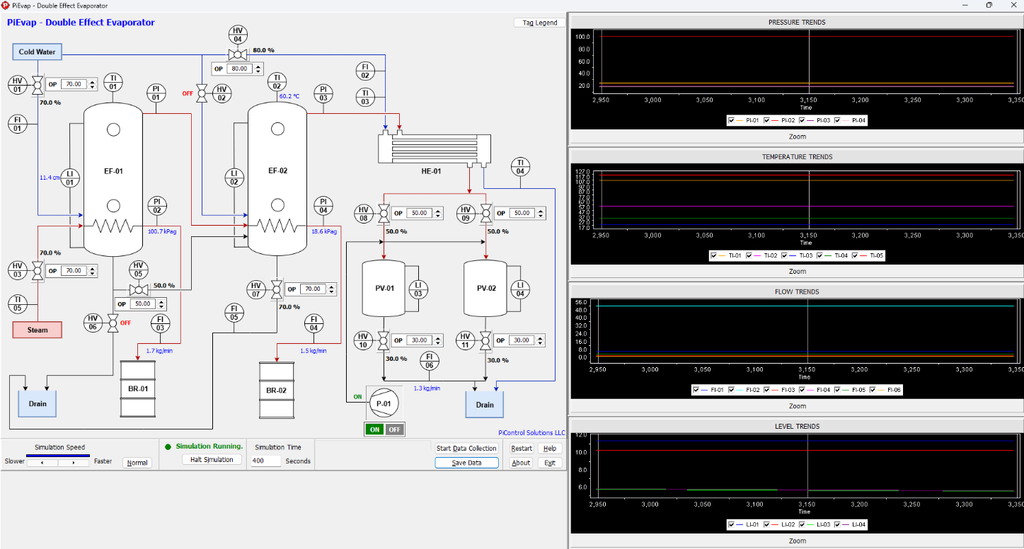
Figure 1. PiEvap – double-effect evaporator process flow diagram at steady-state operating conditions, with live pressure, temperature, flow, and level trends.
Everything You Need to Calculate Steam Economy Is Already on the Screen
Steam economy — total water evaporated across both effects per unit of live steam consumed — is the number that decides whether a double-effect evaporator was worth the capital that built it [7]. It is also the best exercise the unit has to offer, because every quantity it depends on is sitting right there on the instruments.
Reach steady state, and the panel gives you the whole calculation. The condensate leaving the steam trap is the live steam you actually consumed. The condensate collected from the first effect’s vapour, after that vapour has given up its latent heat in the second effect’s coil, is the first effect’s evaporation rate. The liquid accumulating in the product vessels is the second effect’s. Take the measured temperatures, look up the latent heats that go with them, and close the mass and energy balances [8]. A well-run unit lands at 130–165% [1][2].
Then check yourself by a completely different route. The cooling water tells the same story from the other side: its flow and its temperature rise give the condenser duty, and the condenser duty divided by the latent heat at the second effect’s temperature gives that same evaporation rate again — this time from energy rather than from collected mass. If the two answers agree, your steady state was real, and your reading of the instruments was sound. If they don’t, something is still moving, or one of your assumptions is wrong. That is precisely the validation an engineer performs before signing off on the performance of a real evaporator.
This is where multi-effect energy integration stops being a diagram and becomes something you have worked out for yourself — and a result you derived is a result you keep [9]. Every instrument PiEvap needs for it is on the screen, updating in real time, waiting for someone to use it.
Built for the Unit Operation, Not Adapted to It
PiEvap is one of a family of unit-operations simulators from PiControl Solutions, alongside PiAbsorb (packed absorption column), PiCoolTower (counter-flow cooling tower), PiDryer-Tray (tray dryer) and SIMCET (PID tuning certification). None of them is a generic trainer with the labels changed. Each one solves the real governing equations of its own unit operation — here, saturation-temperature relationships, latent heats, coupled mass and energy balances across two effects, valve flow laws and hydrostatic transfer — continuously, in real time, in response to whatever the user does next.
You set the starting levels in both effects, the feed water temperature, the cooling water inlet temperature and the ambient temperature before the run begins — and ambient genuinely matters, because vessel heat losses are computed against it. When the run is finished, everything the instruments recorded is exported to a time-stamped CSV file with those starting conditions written into the header, ready for analysis, a report, or a grade.
Conclusion
The distance between understanding multi-effect evaporation and being able to start one is much wider than most engineers discover until they are standing in front of the equipment with people waiting on them.
PiEvap closes that distance the only way it can honestly be closed — by making the wrong valve order fail the way it fails in a real plant, letting the vacuum collapse for the same three reasons it collapses on real equipment, and then leaving the number the whole exercise is about for the engineer to work out. Engineers who work through a full startup arrive at the real unit already knowing what every valve does, what steady state looks like, and how much steam a second effect is actually worth [10].
For more information on PiEvap and the full PiControl simulator portfolio, contact info@PiControlSolutions.com or call us at +1 832 495-6436.
References
McCabe, W.L., Smith, J.C., and Harriott, P., Unit Operations of Chemical Engineering, 7th ed., McGraw-Hill, New York, 2005, Chapter 16: Evaporation. ↩︎
Kern, D.Q., Process Heat Transfer, McGraw-Hill, New York, 1950, Chapter 14: Evaporation. (Classical reference for multi-effect steam economy calculations.)↩︎
Coulson, J.M. and Richardson, J.F., Chemical Engineering, Vol. 2: Particle Technology and Separation Processes, 5th ed., Butterworth-Heinemann, Oxford, 2002, Chapter 14: Evaporation↩︎
Perry, R.H. and Green, D.W. (Eds.), Perry’s Chemical Engineers’ Handbook, 9th ed., McGraw-Hill, New York, 2019, Section 11: Heat-Transfer Equipment — Evaporators.↩︎
Geankoplis, C.J., Transport Processes and Separation Process Principles, 4th ed., Prentice Hall, Upper Saddle River, 2003, Chapter 8: Evaporation.↩︎
International Association for the Properties of Water and Steam, “Revised Release on the IAPWS Industrial Formulation 1997 for the Thermodynamic Properties of Water and Steam” (IAPWS-IF97), 2007.↩︎
U.S. Department of Energy, Improving Steam System Performance: A Sourcebook for Industry, 2nd ed., Advanced Manufacturing Office, 2012.↩︎
Felder, R.M. and Rousseau, R.W., Elementary Principles of Chemical Processes, 4th ed., Wiley, Hoboken, 2016, Chapter 8: Balances on Nonreactive Processes.↩︎
Feisel, L.D. and Rosa, A.J., “The Role of the Laboratory in Undergraduate Engineering Education,” Journal of Engineering Education, Vol. 94, No. 1, 2005, pp. 121–130.↩︎
Smith, J.M., Van Ness, H.C., and Abbott, M.M., Introduction to Chemical Engineering Thermodynamics, 8th ed., McGraw-Hill, New York, 2018, Appendix: Steam Tables.↩︎