PiControl Solutions
  • PiControl Solutions
  • PiHEx-Bench

    Request More InFo

    Real-Time Bench-Top Heat Exchanger Simulator

    Experience double-pipe and shell-and-tube heat exchanger dynamics in real time — purpose-built for chemical engineering education, process training, and research.

    info@PiControlSolutions.com, Tel: (832) 495-6436

    Click on Schedule a Demo to download and to examine a full-blown demo of PiHEx-Bench.

    Schedule A Demo

    Overview

    PiHEx-Bench is an advanced, interactive chemical engineering simulator that models a bench-scale heat exchanger service unit in real time. The simulator reproduces both a double-pipe (tubular) exchanger and a shell-and-tube exchanger, each operable in co-current (parallel) or counter-current flow — eight distinct experimental configurations from a single instrument panel.

    Users control the hot water pump, the hot and cold water flow valves, and the flow configuration, and observe the immediate effects on inlet and outlet temperatures, flow rates, the log-mean temperature difference, the overall heat transfer coefficient, and exchanger effectiveness. All process variables update continuously, giving the feel of operating a real instrument panel rather than running a static textbook calculation.

    Developed by PiControl Solutions LLC, PiHEx-Bench supports courses in heat transfer, unit operations, and process control at universities and colleges worldwide. It runs equally well as a standalone desktop training tool for process engineers and technicians working with industrial heat exchange equipment.

    Schedule A Demo

    Key Features

    • Real-Time Simulation: Physics engine updates every second. All instruments respond dynamically to valve and pump changes, just as in a physical laboratory.
    • Two Exchanger Geometries, One Instrument Panel: Switch between a double-pipe (tubular) exchanger and a shell-and-tube exchanger from the startup screen — each with independently configurable tube diameter, length, tube count, and overall heat transfer coefficient — without leaving the application.
    • Co-Current and Counter-Current Flow: A single click reroutes the cold water path, automatically switching four solenoid valves and reversing the effective inlet/outlet role of the two cold-side temperature indicators — giving eight distinct experimental runs (2 exchangers × 2 flow directions × 2 flow rates) from one rig.
    • Temperature-Dependent Fluid Properties: Specific heat and density are computed from temperature-dependent polynomial fits to steam-table data rather than fixed constants, so the energy balance reflects how water properties actually vary across the hot and cold streams.
    • NTU-Effectiveness Heat Transfer Model: Both exchanger types use the standard ε-NTU method — the double-pipe exchanger with the classical co-current/counter-current formulas, and the shell-and-tube exchanger with the 1-shell-pass TEMA effectiveness formula for counter-current operation.
    • Startup Configuration Screen: Tube diameter, tube length, number of tubes, overall heat transfer coefficient, and hot/cold water supply temperatures are entered before the simulation begins, with input validation against realistic engineering ranges.
    • Real-Time Trend Charts: Separate chart panels display time-histories of all four temperatures and both flow rates. Charts scroll automatically and can be zoomed for detailed transient analysis.
    • Data Logging & CSV Export: All process variables are logged at every simulation step and exported to a comma-separated values (CSV) file for post-processing in Excel, MATLAB, or Python.
    • Configurable INI File: Flow-meter dynamics (gain, dead time, time constant) and the shell-and-tube parallel-flow correction factor are stored in a plain-text INI file, allowing instructors to recalibrate the model without recompiling the software.
    • No Internet Connection Required: Installs and runs entirely on a Windows PC. No licence server, no cloud dependency, and no user data ever leaves the local machine.
    Schedule A Demo

    Process Diagram & Instruments

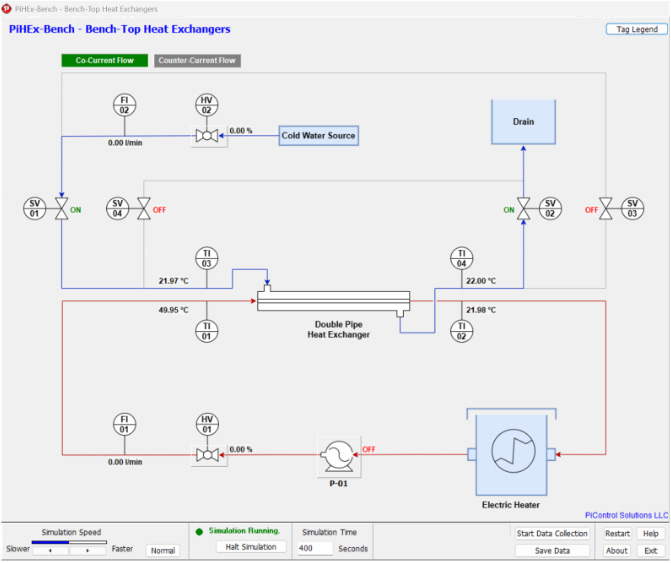
    The main window displays a P&ID-style process diagram of the bench-top heat exchanger loop. The heat exchanger graphic changes automatically to match the selected type — a single concentric tube for the double-pipe exchanger, a multi-tube bundle for the shell-and-tube exchanger. Valve and pump icons open on-screen control panels; all instrument readings update every simulation second.

    Tag

    Description

    Unit

    Typical Range

    HV-01

    Hot water flow control valve

    %

    0 – 100

    HV-02

    Cold water flow control valve

    %

    0 – 100

    P-01

    Hot water circulation pump

    ON/OFF

    TI-01

    Hot water inlet temperature

    °C

    30 – 95

    TI-02

    Hot water outlet temperature

    °C

    20 – 90

    TI-03

    Cold water — left port (inlet co-current / outlet counter-current)

    °C

    5 – 40

    TI-04

    Cold water — right port (outlet co-current / inlet counter-current)

    °C

    5 – 40

    FI-01

    Hot water volumetric flow rate

    L/min

    0 – 10

    FI-02

    Cold water volumetric flow rate

    L/min

    0 – 10

    PiHEx-Bench main process diagram
    Figure 1. PiHEx-Bench main process diagram — P&ID view with live instrument readings.

    Real-Time Trends & Data Export

    PiHEx-Bench continuously logs and plots key process variables. Real-time scrolling trend charts are provided for:

    • Temperatures: TI-01 (hot inlet), TI-02 (hot outlet), TI-03 and TI-04 (cold water — port assignment depends on flow configuration)
    • Flow rates: FI-01 (hot water) and FI-02 (cold water)

    All data can be exported to a CSV file at any time. The export includes a timestamped header — heat exchanger type, flow configuration, and overall heat transfer coefficient — and a column for each instrument tag, making it straightforward to import into Excel, MATLAB, or Python for LMTD, U, and effectiveness calculations.

    Target Audience

    • Chemical Engineering Students: Visualise and experiment with double-pipe and shell-and-tube heat exchanger theory studied in heat transfer and unit operations courses. Calculate LMTD, overall heat transfer coefficient, and effectiveness from live readings — no physical equipment required.
    • Process Engineers & Technicians: Use the simulator for preliminary exploration of heat exchanger performance at different flow rates and configurations before implementing changes on real plant.
    • Educators & Instructors: Design structured experiments around LMTD, energy balance closure, NTU-effectiveness, and TEMA correction — or demonstrate live how switching flow configuration changes outlet temperatures and exchanger performance.
    • Researchers: Validate heat transfer correlations, explore NTU-effectiveness model parameters, and generate synthetic steady-state and transient datasets for comparison with experimental data.

    Benefits

    • Hands-On Without the Hazards: Bench-top heat exchanger experiments involve hot circulating water and pressurised flow lines. PiHEx-Bench eliminates all associated risks while preserving the full learning value of a real startup, steady-state run, and configuration comparison.
    • Cost-Effective: No equipment, consumables, or maintenance costs. A single software licence supports an entire class of users simultaneously.
    • Flexible & Repeatable: Users can reset the simulator instantly and repeat startup procedures or steady-state experiments as many times as needed — impossible on shared physical equipment with limited laboratory hours.
    • Accessible Anywhere: Runs on any Windows PC. Users can continue their work at home, in the library, or remotely — making it ideal for hybrid and online delivery.
    • Instructor Customisable: The plain-text INI configuration file lets instructors adjust flow-meter dynamics and the shell-and-tube correction factor to create different operating scenarios without modifying source code.
    • Industry 4.0 Ready: Simulates a process operator station experience, preparing users for the digital control environments found in chemical, petroleum, and power generation heat exchange operations.

    System Requirements

    Component

    Requirement

    Operating System

    Windows 10 or Windows 11 (64-bit recommended)

    Processor

    1 GHz or faster (Intel / AMD)

    Memory

    512 MB RAM minimum; 2 GB recommended

    Display

    1280 × 720 or higher resolution

    Storage

    50 MB free disk space

    Additional Software

    Microsoft Visual C++ Redistributable (included in installer)

    Internet Connection

    Not required for normal operation

    Available Documentation

    • User Manual: Step-by-step guide to all simulator features: startup screen, process diagram, valve and pump controls, flow configuration, real-time trends, CSV data export, and the Tag Legend.
    • Case Study: Eight guided experimental runs across both exchanger types, flow configurations, and flow rates — covering energy balance closure, LMTD, overall heat transfer coefficient, NTU-effectiveness, and TEMA correction — with startup procedures, data tables, equations, exploration tasks, and discussion questions.
    • Configuration Reference: Description of every parameter in PiHExConfig.INI with units, default values, physical basis, and guidance for customisation.

    Get PiHEx-Bench

    Request a demo, ask about pricing, or schedule an online walkthrough.

    Phone:  (832) 495-6436

    Email:  info@PiControlSolutions.com

    Website:  www.picontrolsolutions.com


    magnifiercross