Integral Windup in PID Controllers: Causes, Consequences, and Anti-Windup Strategies
Est. Reading: 6 minutes
Integral Windup in PID Controllers: Causes, Consequences, and Anti-Windup Strategies 3
Meta description
Learn why integral windup occurs in PID controllers, how it affects process performance, and which anti-windup strategies work best.
Integral windup can turn a routine process upset into prolonged overshoot, slow recovery, and avoidable actuator stress.
What Is Integral Windup?
A PID controller combines proportional, integral, and derivative actions. The integral term accumulates the error between the setpoint (SP) and process variable (PV) over time, which allows the controller to remove steady-state offset. Trouble begins when the controller requests more—or less—actuation than the final control element can deliver.
Consider a temperature loop in which the steam valve is already 100% open while the measured temperature remains below its setpoint. The error persists, so a basic integrator continues to increase even though the valve cannot open any further. The controller’s internal demand then separates from the output that is physically applied to the process.
When the temperature finally approaches the setpoint, or when the constraint disappears, the stored integral action must unwind before the controller can regain normal authority. The result may be overshoot and a long recovery. This behavior is called integral windup, or reset windup.
Why Windup Occurs
Actuator saturation
Every final control element has limits. A valve cannot move beyond its mechanical travel, a variable-frequency drive has minimum and maximum speed, and a heater has finite power. The DCS or PLC may impose narrower limits for safety or equipment protection. Windup develops when the calculated output exceeds one of these limits while the integrator continues responding to the remaining error.
Unreachable operating targets
A large setpoint step can hold the output at a limit for an extended period. The same situation occurs when the target is physically unreachable because of insufficient utility pressure, reduced heat-transfer capacity, an undersized actuator, a process bottleneck, or a major disturbance. Additional integral action cannot overcome a capacity limitation.
Mode and structure changes
The PID calculation may also become temporarily disconnected from the plant. Typical examples include manual mode, a cascade secondary loop at a limit, an override selector that has chosen another controller, or a valve that does not follow its command. Without tracking or external reset feedback, an inactive controller may continue integrating an error it cannot influence.
Aggressive integral action
Fast integral tuning does not create actuator saturation by itself, but it can build stored action quickly once a constraint is reached. Incorrect controller direction, poor scaling, or a mismatch between the configured PID equation and the actual DCS or PLC algorithm can make the response more severe.
Consequences in the Plant
The clearest symptom often appears after the process starts recovering: the PV passes its target, but the controller is slow to reverse. The loop may show excessive overshoot, a long settling time, repeated cycling, or an output that remains pinned even after the error has changed direction.
The effects can extend beyond one trend. Temperature or composition excursions may increase off-spec production; aggressive valve movement can add mechanical wear; long recovery can reduce throughput; and interacting or cascade loops can spread the upset. Windup also complicates startups, grade changes, shutdowns, and manual-to-automatic transfers.
How to Recognize Windup
Do not diagnose windup from PV oscillation alone. Similar behavior can result from poor tuning, valve stiction, excessive dead time, loop interaction, or measurement noise. Instead, look for a sequence that connects a sustained constraint to delayed recovery.
The output remains at its high or low limit while the SP–PV error continues in the same direction.
The calculated output or integral contribution moves beyond the applied output, if those internal values are available.
After the error changes sign, the output remains at the limit longer than the physical process requires.
The problem follows a large setpoint change, major disturbance, mode transfer, selector change, or downstream constraint.
Performance improves when integral action is reduced, but the underlying saturation condition remains.
Trend SP, PV, calculated output, applied output, valve position feedback, mode, limit status, and relevant selector signals on the same time axis. The gap between what the controller requests and what the process receives is often the most revealing evidence.
Anti-Windup Strategies
An output limit is necessary, but limiting the final signal alone may not protect the internal integrator. The controller must also stop or reverse inappropriate integral accumulation. The best method depends on the control platform, process dynamics, loop architecture, and frequency of operation at constraints.
Conditional integration
Conditional integration, also called clamping, pauses integration when the output is at a limit and the error would push it farther into saturation. Integration resumes when the error would move the output back into the available range. The logic must account for direct or reverse control action.
Back-calculation
Back-calculation compares the unconstrained controller demand with the limited output. Their difference is fed back to the integrator through a tracking gain, driving the internal state toward an achievable value. This can provide smoother recovery than simply freezing the integrator, although the tracking dynamic must be selected carefully.
Integrator limits
Direct bounds on the integral state can be useful when process constraints are fixed and well understood. Those bounds must be consistent with the proportional, derivative, bias, and feedforward contributions; otherwise, the total PID output may still behave unexpectedly.
External reset feedback
In cascade, override, split-range, and selector-based structures, the relevant constraint may exist outside the PID block. External reset feedback makes integral action track the signal that is actually selected or applied downstream. This prevents a controller that is not currently in charge from accumulating an unrealistic internal demand.
Setpoint and transfer management
Setpoint ramps, target limits, and bumpless transfer reduce the events that provoke windup, especially during startup or large production-rate changes. They complement rather than replace anti-windup logic because an unexpected disturbance or equipment limitation can still saturate the actuator.
Implementation Workflow
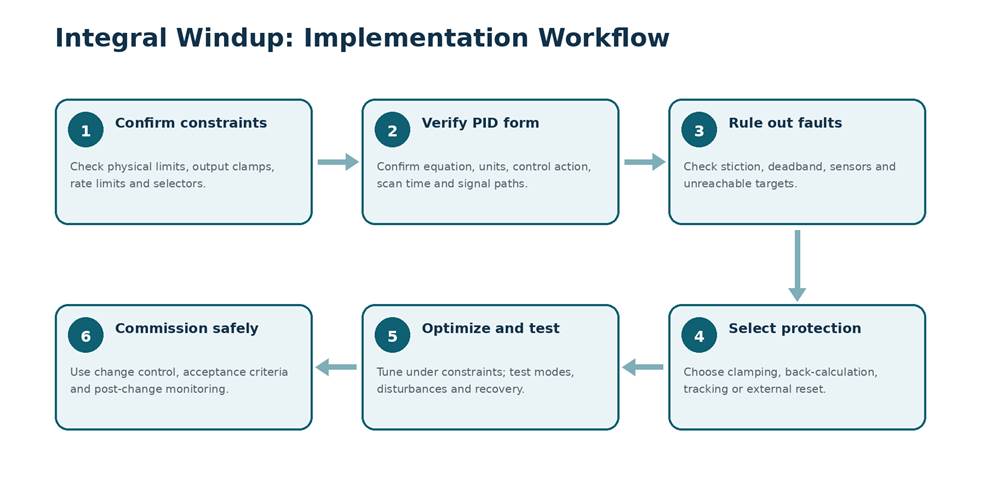
A disciplined workflow keeps anti-windup changes focused on the real constraint instead of masking an equipment or process problem.
Integral Windup in PID Controllers: Causes, Consequences, and Anti-Windup Strategies 4
Figure 1. A practical workflow for diagnosing and addressing integral windup.
During the optimization and testing stage, PITOPS can support process-model and tuning what-if analysis, while SIMCET provides a risk-free setting for engineers to observe how tuning choices affect loop response before working on a live process.
After commissioning, monitor both normal operation and known limiting cases. Acceptance criteria should cover overshoot, settling time, time spent at output limits, mode-transfer behavior, and actuator movement—not only the response to a small setpoint step.
Common Implementation Mistakes
Assuming that an output clamp automatically protects the integrator.
Retuning the loop before confirming whether the target is physically achievable.
Ignoring the difference between calculated output, selected output, and actual valve position.
Testing only setpoint tracking while overlooking disturbance rejection and mode transfers.
Applying custom logic without verifying the PID equation, execution order, and vendor-supported tracking functions.
A robust design treats windup as a control-structure issue first and a tuning issue second. Tuning can reduce how quickly stored action develops, but it cannot restore control authority when the actuator is already constrained.
FAQ
Is integral windup the same as output saturation?
No. Saturation means that the applied output has reached a limit. Windup occurs when the integral state continues accumulating, or fails to track the constrained output, during that condition. A loop can enter saturation briefly without severe windup if its protection is configured correctly.
Can PID retuning eliminate windup?
Less aggressive integral action may reduce the severity, but tuning alone does not remove the structural cause. If an actuator saturates or a controller loses authority, dedicated anti-windup or tracking logic is still required.
Which is better: clamping or back-calculation?
Neither method is universally better. Clamping is simple and transparent, while back-calculation offers a tunable and often smoother recovery. The process dynamics, controller architecture, available platform functions, and commissioning tests should guide the choice.
Does every DCS or PLC PID block include anti-windup?
Many industrial PID blocks provide anti-reset windup, output tracking, or bumpless transfer, but names, defaults, equations, and behavior differ. Verify the exact vendor documentation and test the configured block instead of assuming that an output limit automatically protects the integrator.
How is windup handled in cascade control?
When the secondary loop reaches a setpoint or output limit, the primary controller should stop driving farther into that constraint or track the achievable secondary demand. Correct limit signaling or external reset feedback is essential.
What data should be collected?
At minimum, collect SP, PV, controller output, operating mode, and limit status. Add calculated output, integral contribution, valve position, cascade or selector signals, and relevant disturbances whenever the platform makes them available.
Build Recovery Into the Design
Integral action is indispensable for eliminating steady-state error, but it must remain connected to what the plant can actually do. When output limits, tracking paths, tuning, and operating transitions are engineered together, saturation becomes a manageable condition rather than a prolonged upset.
If your team is investigating slow recovery or recurring saturation, start by reviewing the loop trends, actuator limits, and PID implementation. Contact PiControl Solutions to schedule a consultation and discuss how your PID loops can achieve faster recovery, more stable control, and more reliable process performance.