From Henry’s Law to Flooding: What a Packed Absorption Column Simulator Teaches That Textbooks Cannot
Est. Reading: 5 minutes
From Henry’s Law to Flooding: What a Packed Absorption Column Simulator Teaches That Textbooks Cannot 3
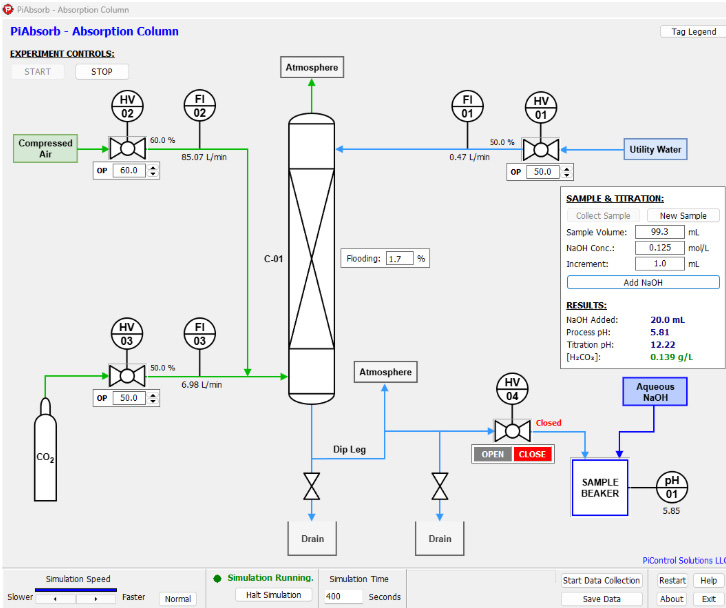
Figure 1. PiAbsorb main process diagram — P&ID view with live instrument readings.
The Gap Employers Keep Finding
In a recent survey of more than 400 chemical industry employers, 63% identified a real deficiency in new graduates’ specialist technical knowledge — not because graduates can’t do the math, but because many have never had to watch the math go wrong in real time [1]. Ask a new graduate to work through the design of a packed absorption column and most can. Ask what actually happens to the outlet chemistry when someone changes the gas rate mid-run, or what a column looks and feels like in the moments before it floods, and the confidence disappears. That gap — between solving the equation and living through the consequence — is exactly what a unit operations lab is supposed to close. It’s also exactly where most programs quietly fall short.
There’s a reason for that. Running a real gas absorption experiment means pressurized cylinders, chemical waste disposal, and a level of supervision most teaching labs can’t sustain every semester. Federal and industry safety records document real, on-the-books incidents involving compressed gas cylinders in laboratory settings — leaks, ruptures, and valve failures serious enough that the cylinder itself becomes the hazard [2], [3]. That’s not a reason to stop teaching absorption. It’s a reason to stop teaching it exclusively through pressurized hardware.
PiAbsorb, developed by PiControl Solutions, is a real-time dynamic simulator of a bench-scale packed absorption column that reproduces the full behavior of the real thing — flooding, live pH dynamics, and a working acid-base titration — on an ordinary Windows PC. To our knowledge, there isn’t another simulator on the market that couples hydraulics, mass-transfer chemistry, and analytical verification into one live, operator-driven system. Most teaching simulations pick a single discipline and simplify the rest. PiAbsorb was built by engineers who design real plant control systems for a living, not by a course-software vendor — and it shows: every valve carries real process lag, every reading carries real instrument noise, and every chemistry result has to be earned by actually operating the process.
What PiAbsorb Simulates
The simulator models a counter-current packed column in which air carrying a controlled load of carbon dioxide rises against a falling water stream. Users control the water rate, the air rate, and the CO₂ rate from a live P&ID-style panel, and two things respond immediately: the column’s flooding condition, and the outlet liquid pH — governed underneath by Henry’s Law equilibrium chemistry — both updating continuously and realistically, complete with the inertia of real valves and the lag of real sensors (Figure 1).
What You Can’t Get From a Textbook Problem
A static textbook problem fixes every variable except one and asks for a single answer. A real — or realistically simulated — column couples all of them simultaneously and forces you to watch the consequences unfold. Four moments come up in almost every structured PiAbsorb session:
Watching the lag, not just knowing it exists
Open the water valve further and the flow reading doesn’t jump — it climbs, the way a real valve and a real run of pipe actually behave. The pH reading lags even further behind that, filtered through its own additional delay. It’s a small thing to read about and an entirely different thing to watch happen — and it’s what teaches every future operator the discipline of waiting for steady state before trusting a number.
Flooding, on purpose
Flooding is one of the most consequential failure modes in a packed column, and one that a real teaching lab will never let a student approach deliberately — the risk isn’t worth it. In PiAbsorb, causing flooding is the assignment. Hold the water rate high, then push the air rate up in stages and watch the flooding indicator climb, calmly at first, then faster, until the column is unmistakably choking — and there’s no instructor standing by to stop it before it happens. Students don’t read about flooding in a textbook margin. They cause it, watch it happen, and back off, which is the only way the concept actually sticks. Then they do it again, because in PiAbsorb the column resets in seconds, not the next scheduled lab slot.
The liquid-to-gas trade-off, discovered rather than derived
The liquid-to-gas ratio is the single most important operating decision on an absorption column, and PiAbsorb makes the trade-off tangible instead of theoretical: push more water through and the outlet pH climbs as the acid load gets diluted; push more gas through and it falls as the acid load increases. Toggling one stream against the other and watching the chemistry respond live teaches the relationship faster than any diagram drawn on a whiteboard.
Instruments lie a little — and that’s the point
Every reading in PiAbsorb carries a touch of realistic instrument noise, the same way a real transmitter never quite settles on a single value. Students learn — the way real operators learn it — that one clean-looking reading isn’t a measurement, and that averaging several readings at apparent steady state is what separates a real number from a lucky one.
The Feature Almost Nobody Else Builds: A Working Titration, Inside a Process Simulator
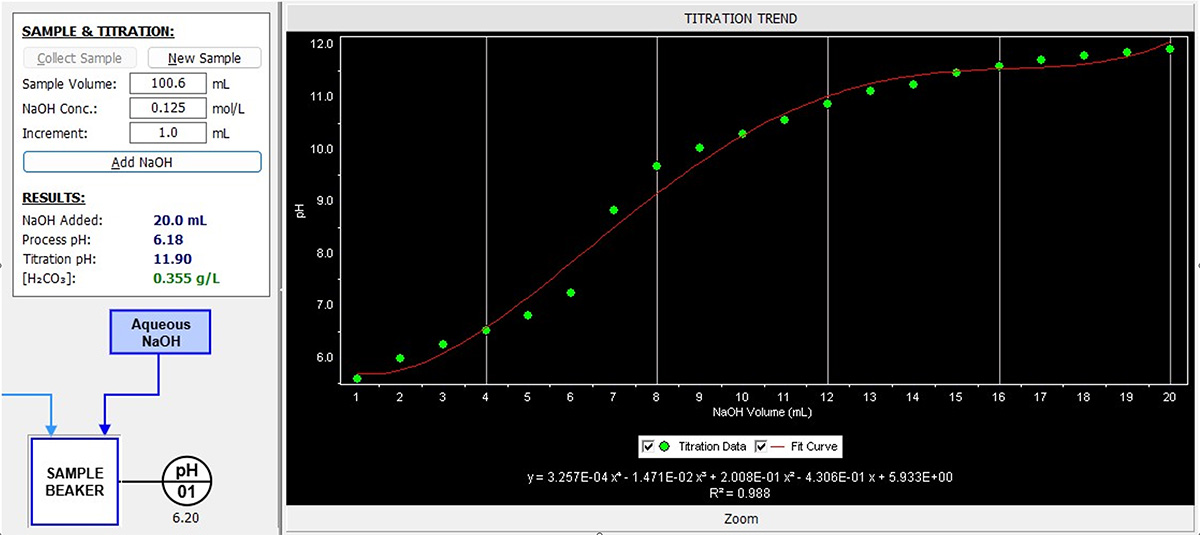
Perhaps the most distinctive thing about PiAbsorb is that it doesn’t stop at the process control panel. At any point in a session, a student can pull a sample from the column outlet and run a genuine acid-base titration against it — adding titrant, watching a real pH response curve form, and locating the equivalence point exactly as they would at an analytical chemistry bench (Figure 2). Then they back-calculate the dissolved CO₂ concentration and check it against the simulator’s own prediction. Two disciplines that almost never share a classroom — process engineering and analytical chemistry — are connected inside a single tool, and the student’s own titration becomes the proof that the simulator’s chemistry is real.
From Henry’s Law to Flooding: What a Packed Absorption Column Simulator Teaches That Textbooks Cannot 4
Figure 2. PiAbsorb virtual titration panel.
The Practical Payoff
No pressurized gas, no chemical waste, no incident reports to file.
Unlimited repetition — reset the column and run the experiment again immediately, something no shared physical column with a two-hour lab slot can offer.
Instructors can reconfigure the column’s underlying physical behavior through a simple settings file, without touching a line of code — different sections of the same course can effectively run different column designs.
Runs on any Windows laptop, on campus or off — works for hybrid and online delivery as naturally as an in-person lab.
Conclusion
The gap employers keep citing isn’t a knowledge gap — it’s an experience gap. Students can solve the equation; what most haven’t done is watch a column flood, wait out a pH lag, or defend a titration result against a model’s own prediction. PiAbsorb was built to close exactly that gap, with a level of physical and chemical realism that, as far as we’ve found, nothing else on the market currently offers. For a unit operations curriculum, that’s not an incremental improvement — it’s the missing piece.
To request a demonstration of PiAbsorb, contact PiControl Solutions at info@PiControlSolutions.com or visit www.picontrolsolutions.com.
References
1. “Bridging the Skills Gap: Enhancing Employability for Chemical Engineering Graduates,” ScienceDirect, Education for Chemical Engineers, 2025.
2. U.S. Department of Energy, Office of Environment, Health, Safety and Security, “Compressed Gas Cylinder Safety,” Safety Bulletin SB 2007-01.
3. “Investigative Analysis of Safety Risk Assessment in University Science and Engineering Laboratories: Focus on High-Pressure Gas Accidents,” ACS Chemical Health & Safety, 2025.
4. R.E. Treybal, Mass-Transfer Operations, 3rd ed., McGraw-Hill, New York, 1980.
5. J.D. Seader, E.J. Henley, and D.K. Roper, Separation Process Principles: Chemical and Biochemical Operations, 3rd ed., Wiley, Hoboken, NJ, 2011.