How AI Is Entering the Control Room – And What It Can (and Cannot) Replace
Est. Reading: 4 minutes
How AI Is Entering the Control Room - And What It Can (and Cannot) Replace 3
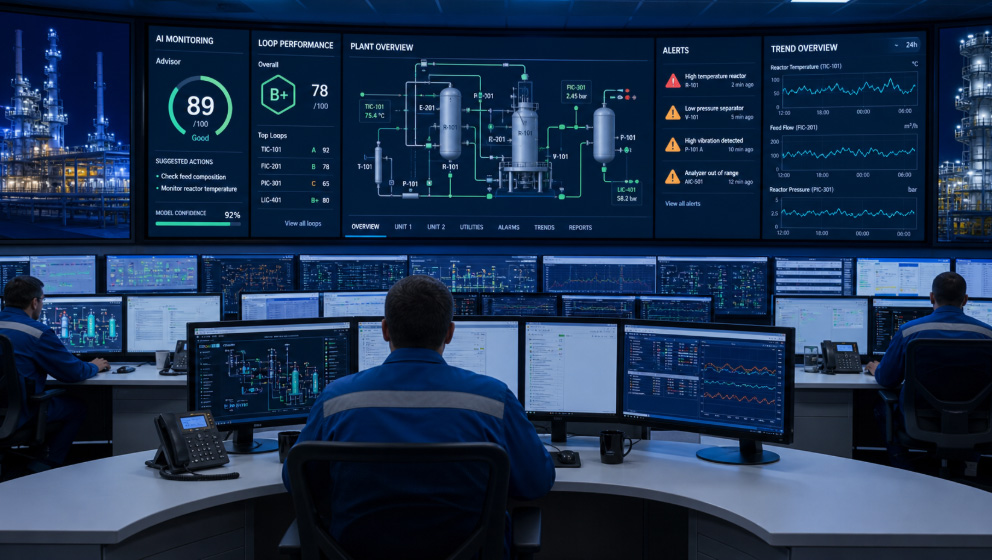
Figure 1: AI-assisted control room with real-time process monitoring dashboards.
Artificial intelligence has moved from the research lab into the plant control room, but the transition is less dramatic than the marketing suggests. AI is entering the control room through a mix of autonomous tuning, predictive alarm handling, and loop-performance diagnostics. These systems can improve efficiency and reduce downtime, but they still operate as decision-support and bounded-automation tools rather than full replacements for process engineers¹. That distinction, between augmenting decisions and replacing judgment, is the real story of AI in industrial control today.
Why So Many Loops Need Help
The scale of the underlying problem explains why AI has found an opening here. Industry data compiled by control engineering researchers indicates that as many as 75 percent of control loops actually increase process variability instead of reducing it, largely because they are poorly configured or poorly tuned². Roughly 85 percent of loops in a typical plant are estimated to run with sub-optimal tuning, and about 30 percent of DCS loops are improperly configured from the start³. Mechanical issues compound the problem: peer-reviewed studies on control valve stiction show that a substantial share of oscillation problems in chemical, paper, and mining plants trace back to sticky or hysteretic valves rather than bad tuning parameters at all⁴. No plant has enough control engineers to manually diagnose and retune thousands of loops against this backdrop, which is exactly the gap AI-based tools are being built to close.
Where Classical Control Still Rules
PID control remains the backbone of the vast majority of regulatory loops in refining, petrochemicals, and manufacturing. The physics of a control loop — dead time, process gain, time constants — do not change because an algorithm is “intelligent.” Research from Towards Data Science on AI-based control strategies notes that classical PID and model-based approaches still solve the majority of well-behaved loop problems efficiently, and that AI-based methods earn their value chiefly in strongly nonlinear, high-dimensional, or fast-changing process conditions where fixed-parameter tuning becomes fragile⁵.
Layer 1: Continuous Diagnostics with APROMON
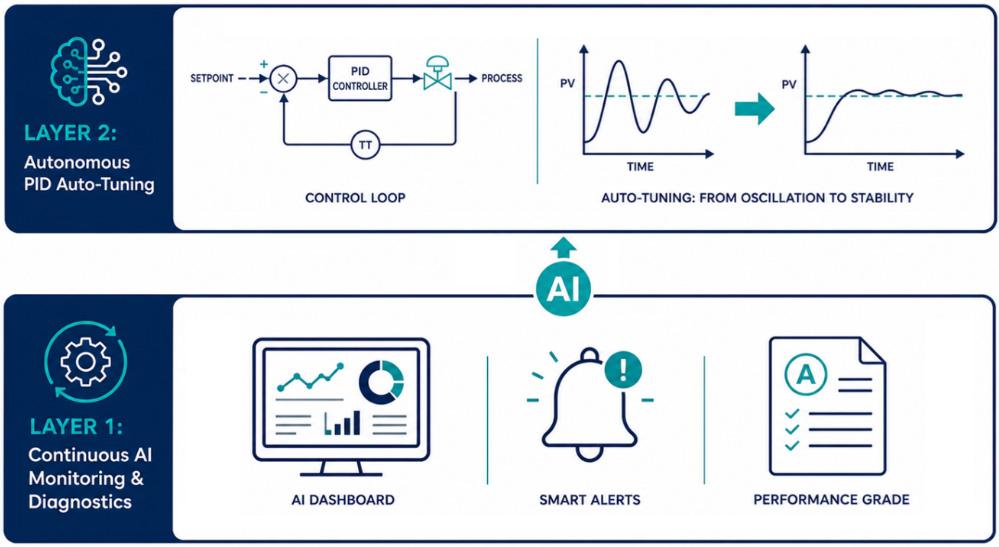
The first practical entry point for AI in the control room is continuous loop monitoring and diagnostics. APROMON, developed by PiControl Solutions, is an AI-based online monitoring and diagnostics product that continuously scores PID, APC, and MPC loops and flags mechanical culprits such as valve stiction, hysteresis, or sensor faults. This addresses a documented industry blind spot: statistical detection methods for control valve stiction, published in Industrial & Engineering Chemistry Research, confirm that valve-related oscillations are widespread and frequently misdiagnosed as tuning problems when the true root cause is mechanical⁴. Continuous, automated screening closes that diagnostic gap far faster than periodic manual loop reviews.
APROMON tells engineers which loops and which valves need attention, and why, before problems compound into yield loss, energy waste, or off-spec product. This diagnostic foundation is what the second layer — autonomous tuning — acts on.
How AI Is Entering the Control Room - And What It Can (and Cannot) Replace 4
Figure 2: Two complementary AI layers in the modern control room — Layer 1 (APROMON) continuously monitors and diagnoses loops; Layer 2 (SUPERTUNE) acts on those diagnostics to retune autonomously.
Layer 2: Autonomous Tuning with SUPERTUNE
The second layer moves from diagnosis to corrective action. SUPERTUNE, developed by PiControl Solutions, is an AI-based auto-tuning engine that continuously monitors loop behavior and adjusts PID parameters in real time — no intrusive step tests, no mode switching, no operator intervention required. This mirrors a broader industry trend: analysis from VisionPlatform.ai on AI agents in industrial control rooms describes a shift from operators manually watching hundreds of variables toward systems that continuously surface what actually needs attention and, increasingly, act on it directly⁶.
This matters operationally because most plants have far more loops than engineering hours available to tune them. Given that roughly 85 percent of loops run with sub-optimal tuning industry-wide, the manual re-tuning workflow simply cannot scale to a facility with hundreds or thousands of PID loops³. What SUPERTUNE replaces is that repetitive re-tuning cycle, not the engineer’s judgment about which loops matter most or how aggressive tuning should be near a safety or quality constraint.
What AI Cannot Replace
Three things remain firmly outside AI’s reach in today’s control room. First, root-cause process engineering — understanding why a distillation column interacts the way it does, or why a reactor exhibits nonlinear gain — still requires a trained process control engineer. Research on AI-driven root cause analysis consistently emphasizes that AI augments human judgment rather than replacing it, and that engineers remain essential for validating findings and implementing corrective action⁷. Second, safety-critical judgment calls, such as how aggressively to tune a loop near an operating constraint, remain a human responsibility; even advanced autonomous control-room systems operate within engineer-defined boundaries and provide advance warning rather than unilateral action¹. Third, mechanical remediation — replacing a sticky valve or recalibrating a sensor once a monitoring tool flags it — is still a maintenance task, not a software one.
A Realistic Path Forward
The pragmatic model emerging across process industries is a two-layer AI stack: continuous diagnostic monitoring to surface which loops and hardware need attention, paired with continuous autonomous tuning for the loops that drift. Tools like APROMON and SUPERTUNE do not eliminate the control engineer’s role; they remove the repetitive detection and correction workload so engineering time is spent on the handful of loops and valves that genuinely need design-level intervention — the same conclusion reached in industry deployments where AI handled continuous monitoring and recommendation while engineers retained final decision authority¹.
References
1. External industry research on AI-enabled control-room decision support and bounded automation, 2026.
2. Control Engineering, “PID: 6 Common Configuration Errors; How Are You Fixing Loop Tuning Problems?” controleng.com, citing ExperTune loop performance statistics, 2025.
3. Control Engineering, “PID: 6 Common Configuration Errors; How Are You Fixing Loop Tuning Problems?” controleng.com, 2025.
4. Damarla, S.K., Sun, X., Xu, F., Shah, A., Huang, B., “Statistical Test-Based Practical Methods for Detection and Quantification of Stiction in Control Valves,” Industrial & Engineering Chemistry Research, 2023, 62(10), 4410–4421.
5. Towards Data Science, “AI for Industrial Process Control: Intro to Control Strategies (Part 1),” towardsdatascience.com, 2025.
6. VisionPlatform.ai, “AI Agents for Industrial Control Rooms,” visionplatform.ai, 2026.
7. Reliability.com, “AI in Root Cause Analysis: How Emerging Tools Are Changing Reliability,” reliability.com, 2026.