How Decarbonization Targets Are Driving a New Wave of PID and APC Investment in 2026
Est. Reading: 6 minutes
How Decarbonization Targets Are Driving a New Wave of PID and APC Investment in 2026 4
Introduction
In 2026, industrial decarbonization has moved beyond voluntary sustainability reports and ESG scorecards. New regulatory frameworks — including the EU’s updated Energy Efficiency Directive (EED) and the EU Clean Industrial Deal — now impose binding energy-intensity reduction obligations on energy-intensive manufacturers in refining, chemicals, and petrochemicals. With carbon border adjustment mechanisms taking effect and internal carbon pricing expanding, plant managers face a hard financial reality: reduce energy-related emissions or pay for them. [1, 2]
The natural instinct is to look at hardware upgrades — new furnaces, heat exchangers, or electrification projects. These investments carry multi-year payback periods and significant capital outlay. Yet industry data consistently shows that one of the fastest, lowest-cost pathways to meaningful energy and emissions reduction is already installed in every plant and is largely underutilized: the process control system. Properly designed and continuously maintained PIDs and Advanced Process Control (APC) strategies can reduce plant energy consumption by 5–15% and increase throughput by 2–8% – without adding a single piece of hardware. [3, 4, 5]
The Hidden Energy Penalty of Poorly Performing Control Loops
A PID control loop that is oscillating does not just cause operational headaches — it wastes energy directly. When a temperature controller oscillates around its setpoint, the associated heating or cooling system cycles continuously, consuming more fuel or utilities than necessary. A pressure controller with excessive integral windup forces compressors to work harder than the process demands. A flow controller that is too sluggish allows upstream and downstream variables to drift, pulling other loops off their optimal setpoints and creating a sequence of inefficiency throughout the unit. [3, 6]
The scale of this problem is well-documented. Industry-wide studies indicate that between 65% and 85% of PID control loops in a typical plant are not performing at their full potential at any given time. Even loops that are well-tuned at commissioning degrade significantly within the first year of operation due to control valve wear and stiction, heat exchanger fouling that shifts process time constants, catalyst deactivation that alters reactor gain, and gradual instrument drift. None of these changes trigger a conventional alarm — they simply erode automatic control quality and quietly inflate energy consumption. [7, 8, 9]
The Carbon Trust has quantified what this means in practice: well-tuned control loops can reduce energy consumption by 5–15%, increase throughput by 2–5%, improve yield by 5–10%, and improve quality consistency by 25–50%. For a mid-size refinery or chemical plant spending tens of millions of dollars per year on fuel and utilities, a 5% reduction is material — and it requires no capital project, no new permits, and no physical plant changes. [3]
How Decarbonization Targets Are Driving a New Wave of PID and APC Investment in 2026 5
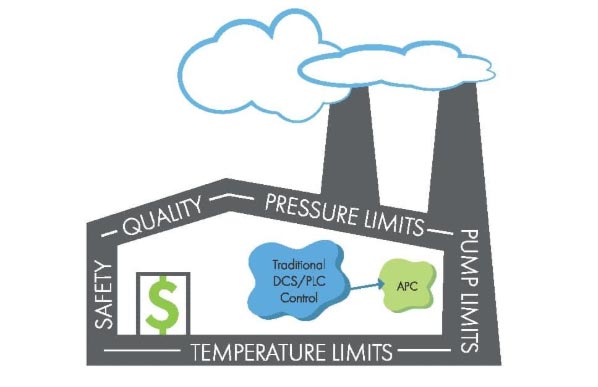
Figure 1. APC control hierarchy showing how advanced setpoints push operations toward physical constraints for maximum energy efficiency. Source: Control Engineering [5].
From PID to APC: Building the Control Stack for Emissions Reduction
The relationship between the PID base layer and higher-level Advanced Process Control (APC) is architectural, not optional. APC or Model Predictive Control (MPC) system sends setpoints to cascaded PID loops in the DCS or PLC. If those base-layer PIDs are sluggish, oscillatory, or frequently placed in manual mode, the APC layer cannot function as designed. Poor base-layer control is the single most common reason APC projects fail to deliver their projected benefits — the control valve and PID simply cannot execute the APC’s optimized moves fast enough or accurately enough. [5, 10]
When the PID layer is healthy, APC delivers transformative results. By coordinating multiple interacting process variables simultaneously and driving operations toward the most energy-efficient feasible point within process constraints, APC consistently reduces steam consumption, minimizes furnace excess air, optimizes reflux-to-feed ratios in distillation, and cuts compressor suction pressure. In refining, where APC adoption has been widespread since the 1990s, documented energy savings of 2–5% of total unit energy consumption per individual unit are routinely achieved, compounding to significant plant-wide reductions. Software tools like PITOPS (PiControl Solutions) enable engineers to design these APC strategies using closed-loop system identification based on past data from normally operating plant— removing the need for disruptive open-loop step tests and allowing new control schemes to be fully validated in simulated environment before touching the live plant. [5, 10, 11, 13]
The combination of stable PID control and well-designed APC is therefore the most direct engineering path to meeting 2026 decarbonization obligations. It is also the most auditable: modern control systems continuously generate the process historian data needed to calculate and report actual energy-per-unit-production KPIs to regulatory bodies, making control performance directly tied to compliance documentation. [1, 5]
Table 1. Documented benefits of PID and APC optimization in process industry plants.
Improvement Area
Typical Benefit Range
Primary Driver
Energy consumption
5–15% reduction
APC & PID optimization
Production throughput
2–8% increase
APC constraint pushing
Product yield
5–10% improvement
APC setpoint optimization
Quality consistency
25–50% improvement
Base-layer PID stability
Control valve life
Extended (reduced wear)
Loop oscillation elimination
Source: Control Engineering [3], Orise [4], Control Engineering / KBC [5, 10].
Continuous Monitoring: Why One-Time Tuning Is Not Enough
One of the most common mistakes plants make is treating PID tuning as a project rather than a process. A control engineer tunes hundreds of loops during a turnaround, declares the work complete, and moves on. Twelve months later, process conditions have shifted, valve trim has worn, and a significant fraction of those carefully tuned loops are degraded. Yet nothing in the alarm system indicates this — because degraded control performance does not trigger conventional high/low alarms. Energy consumption creeps upward, emissions rates increase, and the plant reports poor progress against its decarbonization targets without understanding why. [6, 8, 9]
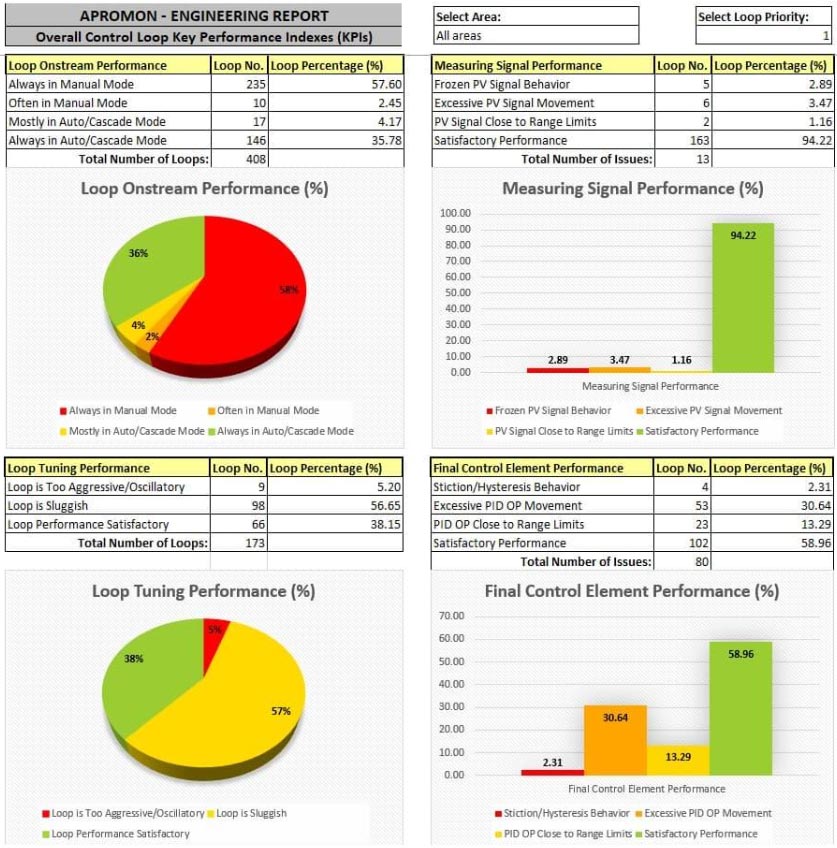
The engineering solution is continuous control loop performance monitoring (CLPM). A CLPM system connects to the DCS or PLC historian in real time and evaluates each loop against a defined set of KPIs — oscillation index, time-in-manual percentage, setpoint tracking error, integrated absolute error (IAE), control valve movement rate, and signal-to-noise ratio. When a loop’s performance grade falls below a threshold, the system flags it for attention, giving the control engineering team a prioritized action list rather than requiring manual trend audits across hundreds of tags. APROMON, PiControl’s AI-based loop monitoring platform, performs exactly this role — connecting to any DCS, PLC, or historian via OPC and distilling over 30 performance criteria per tag into a single intuitive Grade (0–100), while also detecting valve stiction and frozen or noisy sensors before they cause process upsets. [6, 9, 12, 14]
How Decarbonization Targets Are Driving a New Wave of PID and APC Investment in 2026 6
Figure 2. Both the PV and controller output (OP) oscillate sinusoidally following a setpoint change. This is the hallmark of aggressive tuning – reducing proportional gain or increasing integral time will reduce or eliminate the oscillation.
Building the Business Case in 2026
The financial case for investing in control system optimization as a decarbonization lever has never been stronger. Carbon costs, energy prices, and regulatory compliance burdens are all escalating simultaneously. The ROI calculation is straightforward: quantify the current energy penalty from poorly performing loops, apply documented industry benchmarks for improvement (5–15% energy reduction, 2–5% throughput gain), and compare against software licensing and engineering costs. Unlike capital projects, control software can often be deployed in weeks, generates returns from the first month of operation, and requires no major maintenance infrastructure. [3, 4, 5, 13]
Plants should also factor in non-energy co-benefits: reduced control valve wear from early stiction detection, fewer process upsets and unplanned shutdowns, improved product quality and reduced off-spec production, and the regulatory compliance and reporting capability that continuous monitoring provides. When these benefits are included, the total value proposition of systematic control system optimization — built around solid process identification, APC design, and continuous monitoring — is one of the most compelling in the industrial energy and sustainability area in 2026. [3, 6, 14]
Conclusion
The 2026 decarbonization imperative is real, binding, and financially consequential. For process industry plants in refining, chemicals, and petrochemicals, the fastest and most cost-effective path to meaningful emissions reduction runs directly through the control room — not through the capital project pipeline. Fixing poorly performing PID loops, deploying well-designed APC strategies, and maintaining control system health continuously with AI-based monitoring tools is the engineering foundation that makes decarbonization targets achievable on an industrial scale. [1, 2, 3, 5]
Plants that embed control system optimization into their decarbonization programs in 2026 will not only meet regulatory obligations more efficiently – they will also build a more competitive, energy-resilient operational foundation for the decade ahead. [13, 14]
References
1. European Commission, “EU Clean Industrial Deal”, European Commission, March 2026. [Online]. Available: https://commission.europa.eu/topics/competitiveness/clean-industrial-deal_en
3. Control Engineering, “Enhancing processes and improving operations with PID loop monitoring”, April 2025. [Online]. Available: https://www.controleng.com/enhancing-processes-and-improving-operations-with-pid-loop-monitoring/
4. Orise, “Advanced Process Control (APC) – Operational Excellence Consulting”, April 2026. [Online]. Available: https://orise.com/process-optimization/operational-excellence-consulting/advanced-process-control/
5. H. Stephens, Control Engineering, “How industries can take advantage of APC like the refining sector”, April 2025. [Online]. Available: https://www.controleng.com/how-industries-can-take-advantage-of-apc-like-the-refining-sector/
7. PiControl Solutions LLC, “PITOPS – Best Online PID Tuning Software”, November 2025. [Online]. Available: https://www.picontrolsolutions.com/products/pitops/
8. K. Starr, ABB, “Control loop performance monitoring – ABB’s experience over two decades”, 2016. [Online]. Available: https://www.scribd.com/document/697492856/2016-Starr-K-Control-loop-performance-monitoring-ABBs-experience-over-two-decades
9. ABB, “ABB Ability Performance Optimization for Control Loops”, May 2026. [Online]. Available: https://new.abb.com/process-automation/energy-industries/service/abb-ability-performance-optimization-for-control-loops
10. KBC, “Advanced Process Control (PACE)”, 2026. [Online]. Available: https://www.kbc.global/process-optimization/technology/advanced-process-control/
11. Yokogawa Electric Corporation, “Energy-Saving Solutions by Advanced Process Control (APC)”. [Online]. Available: https://www.yokogawa.com/library/resources/yokogawa-technical-reports/energy-saving-solutions-by-advanced-process-control-apc-technical-report/