What Does a Process Control Audit Actually Look Like? A Step-by-Step Walkthrough
Est. Reading: 6 minutes
What Does a Process Control Audit Actually Look Like? A Step-by-Step Walkthrough 3
The Problem Hidden Behind Quiet Alarms
Most plant managers operate with reasonable confidence that their control system is performing. The DCS overview is green, setpoints are being tracked, and conventional alarms are quiet. Yet decades of industrial data tell a different story. A landmark 2001 study by Desborough and Miller at Honeywell, surveying more than 26,000 control loops across 26 companies, found that only one-third of industrial controllers delivered acceptable performance — and 42% were either oscillating or operating in open-loop (manual) mode (1). That finding has been replicated consistently ever since.
These losses are not random. They accumulate gradually through valve packing wear, heat exchanger fouling that shifts process time constants, catalyst deactivation, and gradual instrument drift — none of which triggers a conventional alarm (2), (3). They simply erode energy efficiency, product quality, and equipment lifespan, quietly and without announcement.
A process control audit is the engineering engagement that makes this invisible degradation visible, quantified, and fixable. The question most plant managers ask is: what does one actually look like?
What an Audit Is – and What It Is Not
A process control audit is not a tuning visit. Tuning a single loop takes hours; an audit examines the entire control architecture — base-layer PID loops, cascade and ratio schemes, control valve health, sensor integrity, and where applicable existing APC or MPC strategies. The output is not a revised set of PID parameters. It is a prioritized, evidence-based findings report with a root-cause diagnosis for every underperforming loop in scope (4).
PiControl Solutions conducts audits remotely, on-site, or as a combination of both — determined entirely by the client’s size, internal capabilities, and geographic constraints. Where a client has internal engineers who can collaborate directly, a fully remote engagement is often the more practical and cost-effective choice. The five-phase workflow below applies in all cases.
Phase 1 – Data Collection and Baseline Screening
Every audit begins with process data, not assumptions. At the outset of the engagement, PiControl engineers request continuous historian data from the client — PV, SP, and OP trends across all control loops in scope. In most cases this is transferred directly via OPC connection; where that is not feasible, the client exports and shares data from their existing historian.
PiControl engineers then systematically screen every loop against more than 30 performance criteria: oscillation index, time spent in manual mode, output saturation, setpoint tracking error, control valve movement rate, and signal noise levels — among others. The screening answers four diagnostic questions per loop:
Is it oscillating, and with what true amplitude?
Is it sluggish, saturated, or frequently running in manual mode?
Are there signs of control valve stiction or instrument signal degradation?
Which loops are generating the highest corrective controller output movement?
The findings at this stage consistently surprise clients. A widely cited industry audit study reported that 41% of sampled loops were oscillating, 24% were saturated, and 16% were running in manual mode – all while appearing stable on standard DCS overview displays (5). Earlier surveys found that more than 30% of PID loops at a typical facility were not operated in their designated automatic mode, representing direct ROI loss from automation systems the plant has already paid for (1). About 30% of all loop oscillation is traceable to valve mechanical problems – stiction and hysteresis – that no amount of retuning can correct (6).
For clients who want to continue monitoring loop health beyond the audit itself, PiControl can deploy APROMON – an AI-based continuous loop monitoring platform – to maintain ongoing visibility across the entire control inventory after the engagement concludes.
Phase 2 – Closed-Loop System Identification and Diagnostics
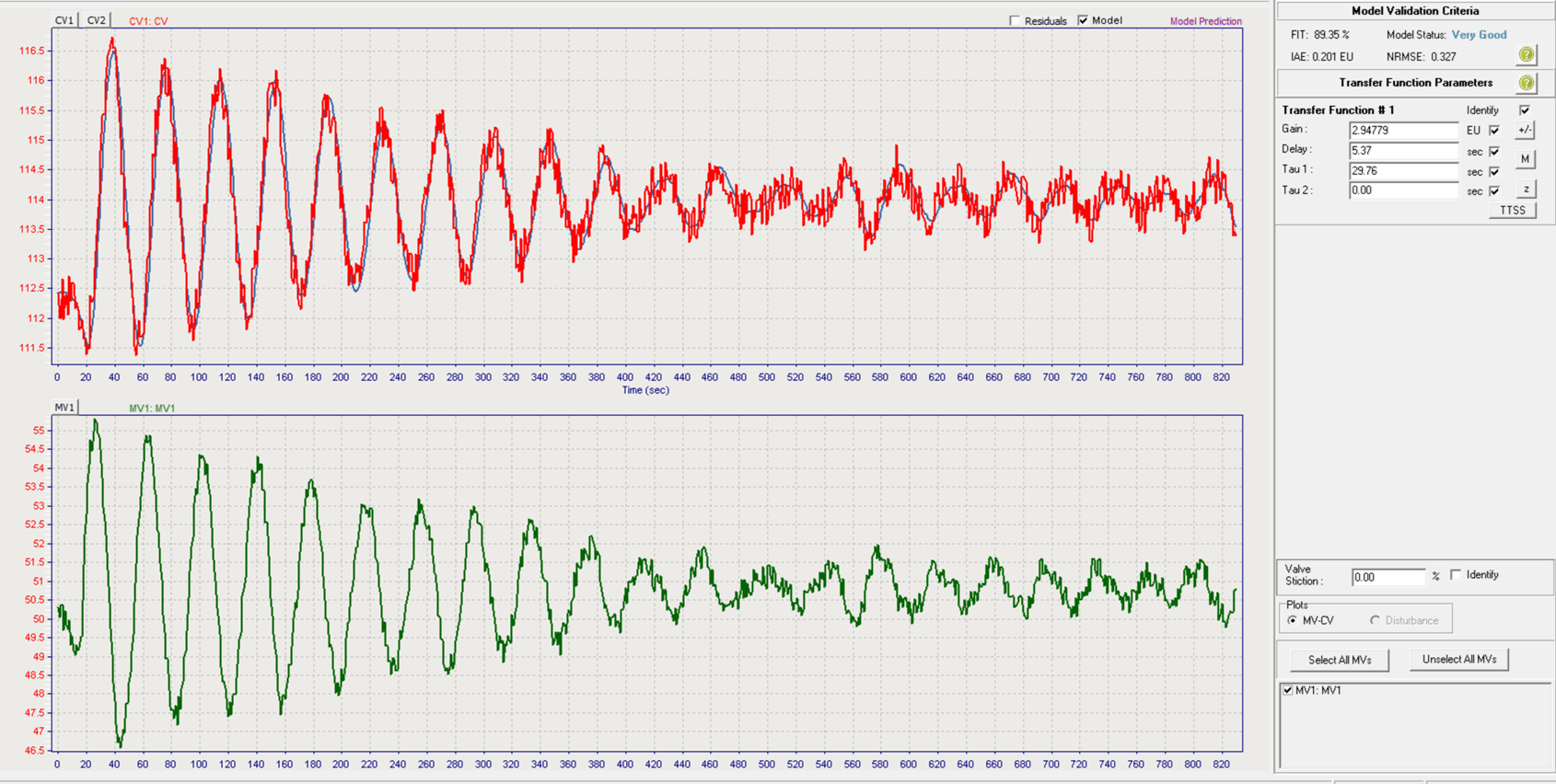
With a ranked priority list in hand, PiControl engineers move into the diagnostic phase. For every flagged loop, engineers perform closed-loop system identification — calculating accurate transfer function models directly from historical operating data collected while loops were running in Auto or Cascade mode, as illustrated in Figure 1. This eliminates the need for open-loop step tests that interrupt production and introduce process risk.
To perform this work, PiControl engineers use PITOPS (Process Identification and Controller Tuning OPtimizer Simulator) — a specialized software tool that supports the identification process by handling data complexity: noise, spikes, missing values, and unmeasured disturbances that would otherwise corrupt the model. The identification itself is an engineering activity — it requires judgment about data selection, disturbance isolation, and model validation that the engineer performs and verifies.
The diagnostic phase produces two critical outputs for each flagged loop:
Accurate process models – the mathematical foundation for calculating optimal PID parameters or designing APC schemes, specific to the current operating conditions of the plant
Stiction index quantification – the minimum controller output change required to produce valve stem movement, converting a visual suspicion about valve condition into a documented, engineering-grade finding that maintenance teams can act on directly with a concrete work order
For plants where process dynamics shift continuously – changing feed compositions, seasonal load variations, aging catalysts – the engineering team also evaluates during this phase whether loops are suitable candidates for SUPERTUNE, PiControl’s automatic adaptive PID tuning technology, where sustained performance requires more than a one-time parameter update.
What Does a Process Control Audit Actually Look Like? A Step-by-Step Walkthrough 4
Figure 1. PITOPS closed-loop system identification output showing identified transfer function model.
Phase 3 – Control Scheme Review
Data analysis resolves most root causes. But some findings only become clear when engineers review the control architecture in context: a valve sized for a throughput the plant no longer runs at, a sensor positioned where it cannot represent the variable it is supposed to control, or a cascade scheme designed for an operating mode that has since changed.
This scheme review is conducted remotely wherever possible — PiControl engineers work through P&IDs and control logic with the client’s own engineering team, review operating procedures, and follow up on loops that raised questions during the screening and identification phases. This collaborative remote approach keeps costs down and avoids the scheduling and travel overhead of an on-site visit. When the complexity of the installation genuinely warrants it (for example, in large or geographically distributed plants, significant scheme redesign, or APC commissioning), PiControl engineers will travel on-site.
This phase also evaluates whether existing APC or MPC strategies remain aligned with the transfer function models developed in Phase 2. Model degradation is one of the most common (and most overlooked) reasons a well-designed APC delivers less than half its original projected benefit within two to three years of commissioning (4).
Phase 4 – Prioritized Findings Report
The audit output is a structured findings report organized by operational impact. Each finding documents the root cause category (tuning, valve mechanical, instrumentation, control scheme, or APC model degradation), the severity derived from the screening and diagnostic data, the recommended corrective action, and — where applicable — the estimated value of remediation based on current operating rates.
The business case for acting on these findings is well-established. The U.K. Energy Efficiency Best Practice Programme quantified that improving regulatory control performance delivers 5–15% reductions in excess energy consumption, 2–5% recovery in lost throughput, and 5–10% improvement in product yield (3). The International Society of Automation reports that well-maintained control systems achieve up to 10% overall process efficiency gains (7). The report also identifies which loops are candidates for adaptive control and which have potential for APC or MPC investment to unlock further margin.
Phase 5 – Implementation and Ongoing Verification
The findings report is a roadmap, not the destination. PiControl engineers implement the corrective actions identified: recalculating and loading new PID parameters, designing and commissioning DCS/PLC-based APC strategies, updating SCADA or HMI logic where scheme changes are required, and refitting degraded MPC models from closed-loop data — again without requiring intrusive step testing.
After implementation, continuous loop monitoring validates that the improvements hold under real operating conditions, provides an objective before/after performance comparison, and flags any early signs of re-degradation. This ongoing oversight replaces the periodic manual audit cycle that most plants cannot sustainably maintain — and ensures the value realized at implementation does not erode quietly over the following months (8).
When Should You Commission an Audit?
The four strongest trigger points are: following a major plant turnaround, when a new APC project is being scoped and a verified performance baseline is required, when energy consumption or product quality has drifted without a clear mechanical cause, and when decarbonization or regulatory targets demand auditable evidence of efficiency improvement. Each situation shares one characteristic – the plant needs a quantified, root-cause diagnosis before making engineering decisions.
Conclusion
A process control audit is one of the highest-return engineering engagements a plant can commission. It requires no new hardware and no production interruption – and it consistently reveals performance losses that conventional DCS alarm systems will never surface. What makes the difference is not the software alone, but the engineering expertise applied at every phase: knowing which data patterns matter, which root causes to prioritize, how to design a control scheme that fits the way the plant actually operates today, and how to sustain performance after the engagement ends.
The gap between what your DCS displays and what your control loops are actually doing is the opportunity. The audit is how you measure it – and PiControl Solutions is how you close it.
References
1. L. Desborough and R. Miller, “Increasing Customer Value of Industrial Control Performance Monitoring — Honeywell’s Experience,” Proceedings of CPC VI, Tucson, Arizona, 2001.
2. D. Ender, “Process Control Performance: Not as Good as you Think,” Control Engineering, Techmation Inc., 1993.
3. U.K. Energy Efficiency Best Practice Programme, “Invest in Control – Payback in Profit,” Department of the Environment, Transport and the Regions, 2001.
4. J. Smuts, “Automation Basics: Closed-Loop Control Troubleshooting,” ISA InTech, March–April 2018. www.isa.org
5. ABB, “Tuning loop: control performance and diagnostics,” ABB Technical Paper. library.e.abb.com
6. N.F. Thornhill and T. Hägglund, “Detection and Diagnosis of Oscillation in Control Loops,” Control Engineering Practice, Vol. 5, No. 10, pp. 1343–1354, Elsevier, 1997.
7. International Society of Automation, cited in Number Analytics, “Control Loop Auditing Essentials.” www.numberanalytics.com/blog/control-loop-auditing-essentials
8. Control Engineering, “Enhancing processes and improving operations with PID loop monitoring,” April 2025. www.controleng.com