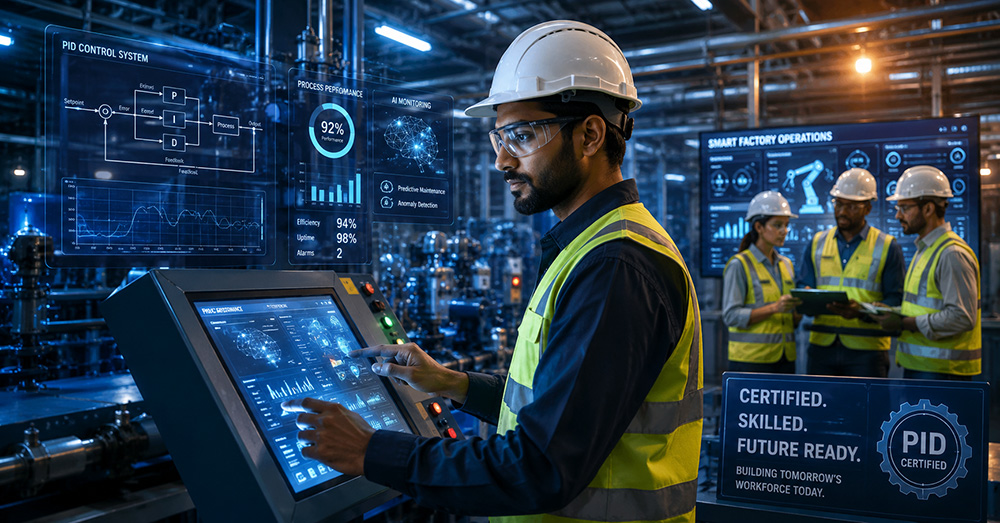
Why PID Certification Matters: Building a Skilled Workforce for the Future
Est. Reading: 4 minutes
Why PID Certification Matters: Building a Skilled Workforce for the Future 2
The Hiring Challenge No One Talks About
You invest significant time and resources into finding the right candidate – only to discover that strong academic credentials do not always translate into day-one readiness. Many engineers arrive with solid theoretical foundations but limited hands-on experience. They understand the equations behind a PID controller, but have never tuned one on a live process, diagnosed an unstable loop, or resolved a real control room upset.
For HR managers and training directors, this gap means longer onboarding timelines, higher training costs, and increased operational risk. The solution is not to lower hiring standards – it is to certify practical competency before it becomes your problem to fix.
PID Control: The Backbone of Industrial Operations
PID controllers are the most widely deployed control mechanism in industrial automation, and controlling temperature, pressure, flow, and level across every major processing sector – from chemical and pharmaceutical plants to food production, power generation, and refining operations.
When properly tuned, PID loops keep production stable, energy use efficient, and product quality consistent. When they are not, the consequences range from costly inefficiencies to equipment damage and safety incidents. Yet despite their critical role, PID tuning and process control remain chronically underrepresented in practical engineering education – leaving organizations to bridge the gap on their own.
As experienced control engineers retire and incoming talent arrives less prepared than ever, the gap in process control competency continues to widen. For HR and training managers, this creates a familiar set of challenges:
Extended onboarding: new hires cannot work independently on control systems without weeks of additional training
Inconsistent skill levels: across teams, departments, and sites
No objective benchmark: for assessing technical competency during hiring
Repeated training costs: with limited measurable outcomes
Intensive internal training programs are resource-heavy, slow, and often inconsistent. What the industry needs is a standardized, validated approach to building process control competency – and that is precisely what professional PID certification delivers.
Why PID Certification Changes the Equation
Certification transforms an abstract claim on a resume into a verified, measurable competency. It provides a common standard that HR managers, technical leads, and training directors can rely on – regardless of where a candidate studied or what their previous employer’s training program looked like.
The value of PID certification operates on two levels: for the individual professional, and for the organization that employs them.
Reduced hiring risk: assess practical capability before extending an offer, not after months of on-the-job evaluation
Faster time to productivity: certified professionals contribute meaningfully from day one
Standardized competency: a consistent performance benchmark across all sites and teams
Lower training costs: certification upfront reduces ongoing informal knowledge transfer and rework
Professional credibility: a recognized certification strengthens career profiles and signals real-world capability
Practical confidence: simulation-based training gives engineers and operators the experience to act decisively under pressure
Clear development pathway: from foundational PID principles to advanced process control expertise
SIMCET and PITOPS: Where Certification Meets Reality
Most training programs tell people what to do. SIMCET and PITOPS make them do it. These two software platforms are the engine behind all PiControl certification – and the reason the training actually works.
SIMCET is a real-time PID simulation and grading platform. It places learners inside live process scenarios – distillation columns, reactors, heat exchangers, compressors, flow and level controllers – and requires them to tune, troubleshoot, and optimize under realistic conditions. There are no passive exercises. Every action produces a measurable process response, and at the end of the course, SIMCET automatically generates a performance report card for each attendee. For training managers, this means one critical thing: objective, data-driven proof of competency.
PITOPS goes further. It enables attendees to work directly with real plant time-series data – identifying process dynamics, building advanced control schemes, and configuring cascades, feedforward controllers, constraint overrides, and model-based controllers, all inside a single software environment. Rather than learning theory and hoping it applies, participants solve the exact kind of problems they will face on the job.
Both platforms are used together throughout PiControl’s certification programs, creating a hands-on learning environment that consistently delivers confidence and capability in a fraction of the time it would take on the job alone. The courses built on this foundation are:
PID100 — PID Tuning Certification and Primary Process Control
2 days classroom / 15 hours online — DCS Technicians, Plant Operators, Instrument & Process Control Engineers
PID100 is the entry point into practical process control mastery. Using both PITOPS and SIMCET, participants work through the full PID tuning cycle – from understanding process dynamics and the PID equation, to conducting step tests, estimating tuning parameters scientifically, and applying optimal tuning across multiple process types. In just two days, attendees gain the kind of hands-on confidence that would otherwise take years to build on the job. The course concludes with timed simulator tests and an automatic grading report – giving training managers a clear, objective measure of each attendee’s capability.
APC200 — Advanced Process Control, PID Tuning and Beyond
3 days classroom / 21 hours online — Process Control Engineers, APC Engineers, Managers & Supervisors — Prerequisite: PID100
APC200 takes everything learned in PID100 and applies it at a system level. Using PITOPS and SIMCET with real plant time-series data, attendees identify multivariable process dynamics, build advanced control schemes – cascade, feedforward, constraint override, dead-time compensation, model-based control – and learn when to use each strategy for maximum impact. The course is designed for engineers who need to unlock the full potential of their DCS or PLC, push against operational constraints, and deliver measurable improvements to plant performance.
Invest in What Keeps Your Processes Running
As industrial systems become more automated and experienced engineers continue to retire, organizations can no longer rely solely on academic qualifications or informal on-the-job learning. The future of industrial performance depends on building teams with verified, practical process control competency.
PID certification through SIMCET and PITOPS provides a structured, measurable, and scalable approach to workforce development. Instead of hoping employees gain experience over time, organizations can ensure engineers and operators are prepared to contribute confidently from day one.
For HR managers and training leaders, certification is more than a training initiative – it is a long-term investment in operational reliability, faster workforce readiness, reduced training inefficiencies, and stronger technical capability across the organization.
The companies that lead the future of industrial automation will be the ones that invest not only in technology, but in the people responsible for running it.
Ready to build a more capable and future-ready workforce? Explore PID certification programs through PiControl Solutions and discover how SIMCET and PITOPS can support your team’s development.